






A metal press catches a worker's finger. A box cutter opens a deep cut across the palm. A numb wrist that seemed manageable yesterday now makes gripping a tool impossible. The first question is usually medical, but the next questions arrive quickly: Who needs to be told, what should be documented, and will the insurance company treat the injury as work-related?
A hand injury at work can affect treatment, wages, job duties, and future earning ability. The safest response combines prompt medical care with disciplined claim preservation. Massachusetts workers' compensation may cover reasonable and necessary medical treatment and disability benefits, but insurers often examine delays, inconsistent descriptions, prior symptoms, and online activity when deciding whether to accept or challenge a claim.
Table of Contents
- Why Hand Injuries Demand Immediate Action
- Critical First Steps After a Hand Injury on the Job
- Reporting and Documenting Your Hand Injury in Massachusetts
- Navigating the Workers' Compensation Claim Process
- Common Mistakes That Undermine Hand Injury Claims
- When to Bring in a Massachusetts Workers' Compensation Attorney
Why Hand Injuries Demand Immediate Action
A worker who crushes a finger may see swelling and bruising but not know whether a tendon, nerve, joint, or bone has been damaged. Someone with a laceration may stop the bleeding, apply a dressing, and return to the line. That decision can create two problems at once. The injury may need more specialized treatment than the worker realizes, and the delay can give an insurer an argument that the condition developed outside work.
Hand injuries have never been a minor category of workplace harm. A U.S. Bureau of Labor Statistics bulletin on work-related hand injuries reported that, in 1980, an estimated 200,000 disabling injuries, about 7.6% of all disabling injuries, involved the hands. The same historical research connected hand injuries with lost work time and disability, which helps explain why hand protection became a central concern in occupational safety programs.
More recent occupational data still show substantial consequences. An industry presentation citing federal labor data reported 186,830 nonfatal occupational hand and wrist injuries involving days away from work, with a median of 5 days away for hand injuries and 15 days for wrist injuries. The figures appear in this workplace hand-safety presentation.
The first hours shape the record
A supervisor's memory changes. A machine may be repaired, a witness may leave the company, and a medical note may later summarize the event in only a sentence. The worker's own account, created promptly and accurately, can preserve the sequence before those details disappear.
The immediate priorities are straightforward:
- Protect the hand: Stop the task, obtain first aid, and follow emergency instructions. A worker shouldn't keep using a damaged hand to avoid appearing difficult.
- Report the event: Tell the supervisor what happened, where it happened, and which hand or finger was affected.
- Get evaluated: A medical professional should assess the injury, even if the wound initially appears small.
- Preserve evidence: Keep photographs, names of witnesses, work restrictions, and treatment records.
Practical rule: A minor-looking injury deserves a prompt record if it happened at work. The later infection, loss of motion, or nerve symptoms may be harder to connect to the job if the original event was never documented.
Medical benefits are a separate concern from wage replacement. Workers seeking an overview of treatment coverage can review Massachusetts workers' compensation medical benefits. The key is not to wait until a claim dispute forces the issue. Early documentation protects the worker's health and gives the claim a coherent starting point.
Critical First Steps After a Hand Injury on the Job
The first response should be calm, specific, and documented. A worker should stop the hazardous activity, obtain workplace first aid if appropriate, and seek medical attention suited to the symptoms. Severe bleeding, an obvious deformity, an amputation, loss of sensation, a deep laceration, or an injury involving a machine generally calls for emergency evaluation rather than a casual appointment.
An urgent care clinic may be appropriate for a less severe injury when the clinic can evaluate the hand and arrange imaging or referral. The choice should be guided by the condition, not by an effort to keep the incident off the employer's radar. Emergency department records often document the mechanism, visible damage, imaging, and initial work restrictions. Urgent care records can also be useful, provided the worker clearly states that the injury occurred during work.
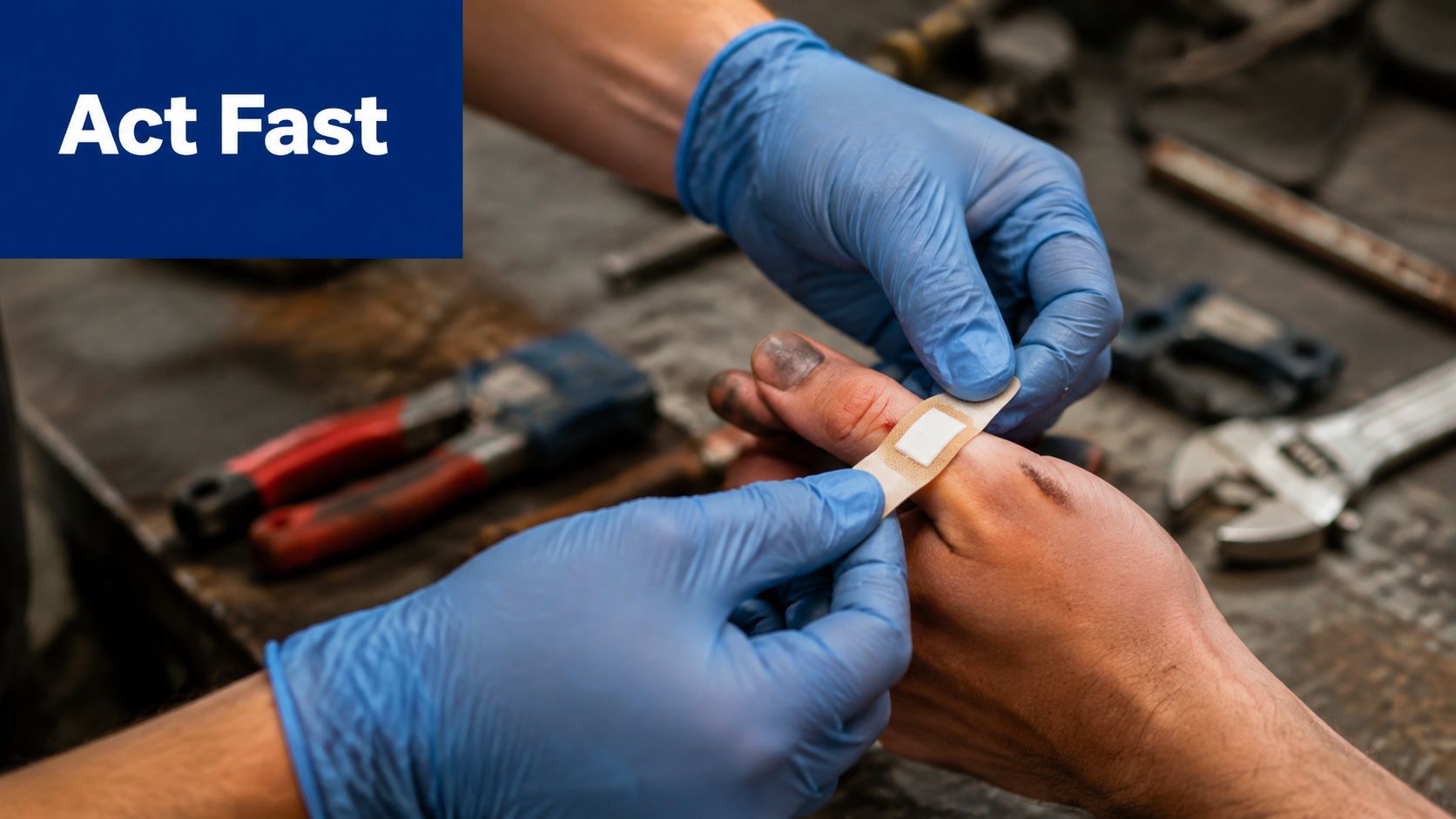
What to do before leaving the job
The worker should tell a supervisor or designated safety representative as soon as practical. A verbal report is better than silence, but it shouldn't be the only record. The worker can follow up with a short written message stating the date, approximate time, location, task, body part injured, and whether medical care was sought.
The description should remain factual. “The blade slipped while the worker was cutting packaging, and the left index finger began bleeding” is stronger than a conclusion such as “the company caused a serious permanent injury.” The worker should avoid guessing about medical diagnoses and should not minimize the event with phrases such as “it's nothing” or “the hand is fine” before an evaluation.
The first 48 hours
A practical checklist includes:
- Attend the evaluation. Tell the clinician exactly how the injury happened and identify every affected area, including numbness, weakness, swelling, or reduced movement.
- Request work restrictions in writing. If the clinician limits lifting, gripping, typing, tool use, or repetitive motion, the restriction should appear in the medical paperwork.
- Keep every document. Discharge instructions, prescriptions, imaging referrals, appointment notices, and work-status forms belong in a personal file.
- Record symptoms daily. Note pain, sensation, range of motion, sleep disruption, and which ordinary tasks have become difficult.
- Avoid self-directed treatment changes. A worker shouldn't remove a splint, skip therapy, or return to full duty merely because the hand feels temporarily better.
An insurer may later argue that a gap in care proves the condition wasn't serious. The worker can counter that argument with consistent attendance, accurate symptom reporting, and a clear explanation for any unavoidable treatment delay. Medical care should come first, but the worker should also understand that every early decision becomes part of the claim record.
Reporting and Documenting Your Hand Injury in Massachusetts
Massachusetts workers' compensation law requires an injured employee to give notice to the employer within a statutory period, commonly described as four years from the date the employee knew or should have known that the injury was related to employment. That deadline doesn't make delay sensible. Late notice can create factual disputes, weaken witness evidence, and allow an insurer to argue that the employer lacked a fair opportunity to investigate.
The employer generally handles the Employer's First Report of Injury, which is submitted through the Massachusetts workers' compensation system when the injury meets reporting requirements. The worker should still maintain an independent record and should ask for copies of incident reports, work-status forms, and claim correspondence. An employer's report may describe the event differently from the worker's account.
Build a contemporaneous record
A useful incident description answers basic questions without speculation:
- What happened: Describe the task and the movement that caused the injury.
- Where it happened: Identify the work area, machine, vehicle, workstation, or delivery location.
- Who saw it: List coworkers, supervisors, customers, or others who were present.
- What changed immediately: Record bleeding, swelling, loss of motion, numbness, or inability to grip.
- What equipment was involved: Preserve the tool or machine information if it may matter later.
- What happened afterward: Identify first aid, reporting, transportation, medical treatment, and restrictions.
Photographs can be valuable, particularly when swelling, bruising, a wound, damaged equipment, or unsafe conditions may change. The worker should preserve original photographs and avoid editing them. Text messages to a supervisor, scheduling records, timecards, safety reports, and messages about modified duty may also help establish timing and work impact.
A verbal report starts the process. A dated written follow-up gives the worker a record that can be checked against later testimony.
The worker should keep a personal journal rather than relying on memory. Each entry can identify symptoms, medication effects, therapy exercises, missed work, modified tasks, and difficulties with dressing, cooking, driving, childcare, or sleep. The journal isn't a substitute for medical records, but it can help the worker describe progression accurately.
For a practical review of workplace communication and documentation issues, injured employees can consult guidance on Massachusetts workers' compensation dos and don'ts. If the insurer denies the claim or the parties dispute disability, the worker may need to file with the Department of Industrial Accidents. Missing a procedural requirement doesn't always end a case, but it makes legal advice more important because exceptions and factual explanations may matter.
Navigating the Workers' Compensation Claim Process
A Massachusetts claim can look simple on paper and become complicated once the insurer asks whether the injury arose out of employment, whether treatment is reasonable, and whether the worker can perform available duties. The insurer may review medical records, employment records, witness accounts, safety materials, and statements given by the worker.
The benefit category depends on functional capacity, not merely the name of the injury. A finger fracture might heal without lasting restrictions. A tendon injury, amputation, nerve condition, or loss of grip can interfere with the worker's actual job and may support a more substantial disability analysis.
Benefit categories in context
| Benefit Type | When It Applies | Key Details |
|---|---|---|
| Temporary total disability | The injury prevents the worker from performing work during the recovery period | The medical evidence should explain why the worker cannot perform the essential duties |
| Partial disability | The worker can perform some work but earns less or cannot perform the former job fully | Restrictions, offered duties, actual wages, and transferable work capacity may matter |
| Permanent and total disability | The lasting condition prevents sustained employment | The analysis focuses on the worker's medical limitations and ability to earn through suitable work |
| Scheduled or specific loss benefits | The injury causes a legally recognized loss or permanent impairment involving a finger, hand, or related function | The nature and extent of the loss must be supported by medical evidence and Massachusetts law |
What happens when the insurer pushes back
A denial may focus on delayed reporting, an alleged pre-existing condition, a claim that the event was not work-related, or a medical opinion that the worker can return without restrictions. The response should address the actual reason for denial rather than only repeating that the hand still hurts.
The worker may be sent to an independent medical examination. That doctor works for the legal process or insurer's side, not as the worker's treating provider. The worker should answer questions accurately, describe limitations consistently, and avoid exaggeration. Bringing a list of medications and restrictions can help prevent omissions, but the worker shouldn't rehearse a scripted account.
If the insurer refuses benefits, the claim can proceed through the Massachusetts Department of Industrial Accidents dispute process. Legal representation can help organize medical proof, prepare testimony, challenge an inadequate examination, and present the issue through conference, hearing, review, or appeal as appropriate.
A separate third-party claim may exist when someone other than the employer contributed to the injury. A defective tool, unsafe machine, negligent subcontractor, property owner, or equipment manufacturer can raise a claim outside workers' compensation. The worker should preserve the product, identify all companies involved, and avoid signing a broad release before the potential claims are evaluated. Workers' compensation and third-party litigation serve different purposes, and one may provide remedies the other doesn't.
Common Mistakes That Undermine Hand Injury Claims
Many hand claims don't fail because the injury wasn't real. They weaken because the record contains avoidable contradictions. The worker tells a supervisor one version, gives the doctor a shorter version, tells an adjuster something different, and then posts a photograph that appears to show unrestricted activity.

Five claim-killers to avoid
- Giving an unprepared recorded statement: The adjuster may sound helpful, but the adjuster represents the insurer. A worker should answer truthfully and briefly, avoid guesses, and obtain advice before agreeing to a recorded interview.
- Posting on social media: A picture of a weekend project, gym visit, vacation, or household task may be presented as proof that the hand functions normally. Even a carefully worded caption can be separated from its context.
- Returning too early: A worker who ignores restrictions to keep a job may aggravate the injury and create confusion about what the original incident caused. Modified duty should match the clinician's written limits.
- Missing appointments: Gaps in care give the insurer an opening to argue that the condition improved or that the worker failed to cooperate with treatment. Rescheduling is better than not appearing.
- Accepting a quick settlement: A release may close future claims before the worker knows whether surgery, additional therapy, permanent restrictions, or occupational retraining will be needed.
Insurer tactic: A claims representative may frame a question as routine, then use one casual answer to challenge the entire injury history. The safest communication is accurate, limited, and consistent.
The worker should also watch for a subtler problem, blaming every symptom on a pre-existing condition without understanding the legal significance of an aggravation. A prior wrist problem doesn't automatically eliminate a new workplace claim. The key questions include what changed, what task caused the change, and what the medical evidence says about work-related aggravation or acceleration.
The same discipline applies to third-party evidence. A damaged blade, defective guard, malfunctioning press, or unsafe worksite may disappear quickly. Photographs, preservation requests, maintenance records, product information, and witness names can be more useful than a later recollection.
A short educational video may help workers recognize communication and claim-handling risks, but it cannot replace individualized legal or medical advice.
When to Bring in a Massachusetts Workers' Compensation Attorney
A worker may be able to report a straightforward injury and follow treatment without counsel. Legal guidance becomes more valuable when the insurer disputes causation, delays authorization, challenges restrictions, blames a prior condition, or offers a settlement before the medical picture is settled.
Hand cases also deserve careful review when the injury involves permanent loss of motion, grip weakness, nerve damage, an amputation, surgery, repeated trauma, or a possible third-party claim. A recurring injury can raise difficult questions about whether the new event caused an aggravation, whether cumulative work contributed, and how disability should be allocated. CDC-based research reported that 14.6% of workers with an acute traumatic occupational hand injury reported at least one earlier work-related hand injury during the prior year, according to the research summary on occupational hand-injury recurrence. That history calls for careful medical and factual analysis, not an automatic denial.
Rehabilitation should be measured by function. A published work-related hand-injury program found significant improvement in self-assessed measures, including DASH and EQ-5D, and reported that 71% of patients with finger injuries returned to work. The PubMed record for that rehabilitation research also sits alongside a systematic review finding occupational therapy improved function, occupational performance, satisfaction, and pain, while cautioning that the evidence had low certainty and substantial variation. A coordinated plan involving range of motion, functional retraining, and job-specific occupational intervention is more useful than treatment aimed only at short-term symptom relief.
Massachusetts counsel can investigate the accident, coordinate medical evidence, address insurer communications, pursue benefits, evaluate third-party liability, and negotiate or litigate when necessary. Fees in workers' compensation matters are generally regulated and typically depend on the outcome or approved fee arrangements, so the worker should ask about fees and costs during the consultation. Shea Culgin Law handles Massachusetts workers' compensation claims, denied claims, disability benefits, and potential third-party matters.
A worker with a hand injury at work should preserve the incident report, medical records, work restrictions, photographs, and insurer letters before contacting counsel. What a workers' compensation lawyer does can help clarify what representation would involve.
If a workplace hand injury has caused missed work, restricted duties, disputed treatment, or lasting symptoms, contact Shea Culgin Law for a case evaluation. Bring the employer's information, medical paperwork, incident details, and any insurance correspondence so the claim can be reviewed before avoidable gaps become harder to correct.