






Partial disability means a worker can still do some work after an injury, but not enough to earn what they earned before. In Massachusetts workers' comp, that usually means the law pays a portion of the wage difference, because the injury reduced earning power even though it did not end work entirely.
A nurse on light duty, a warehouse worker on shorter shifts, or a laborer moved into a lower-paid bench job can all run into the same problem. The paycheck drops, the medical restrictions are real, and the insurer often starts asking whether the worker can still earn equivalent wages somewhere else.
Table of Contents
- Returning to Work After an Injury Without Full Pay
- How Massachusetts Defines Partial Disability
- Partial Disability Versus Total Disability
- Calculating Partial Disability Benefits in Massachusetts
- Why Insurers Dispute Partial Disability Claims
- A Real-World Massachusetts Partial Disability Scenario
- Protecting Your Claim and Getting the Right Help
Returning to Work After an Injury Without Full Pay
A worker gets cleared to return after a back injury, but only for shorter shifts and no lifting over a certain amount. The employer offers light duty, the hours shrink, and the paycheck comes in lower than before. That is often the moment partial disability stops being an abstract term and becomes a household problem.
Partial disability is a core concept in U.S. workers' compensation and disability systems because it describes a worker who can still perform some work, but with reduced capacity or reduced earnings after an injury or illness. The labor-market gap in disability data helps explain why it matters. In 2025, only 22.8% of people with a disability were employed, compared with 65.2% of people without a disability, and workers with a disability were nearly twice as likely to work part time as those without a disability, according to the Bureau of Labor Statistics disability release. BLS disability data
A partial disability claim is usually about wage loss, not just pain or diagnosis.
For an injured Massachusetts worker, that distinction matters because the claim is not asking whether the person is “hurt enough.” It asks whether the injury left the worker able to earn the same money, on the same schedule, doing the same kind of job. If the answer is no, partial disability may fit even when the worker is back on the clock.
The practical test is simple. Can the worker still do part of the job, but not all of it, or not at the same pay? If so, the case may belong in the partial disability category rather than the total disability bucket. That is why a return to work does not automatically end a claim, and why a smaller paycheck can be the start of a valid benefit dispute rather than the end of one.
For readers comparing wage-loss rules with broader disability benefits, Shea Culgin Law's overview of disability wage replacement is a useful reference point for how reduced earnings are analyzed in practice.
How Massachusetts Defines Partial Disability
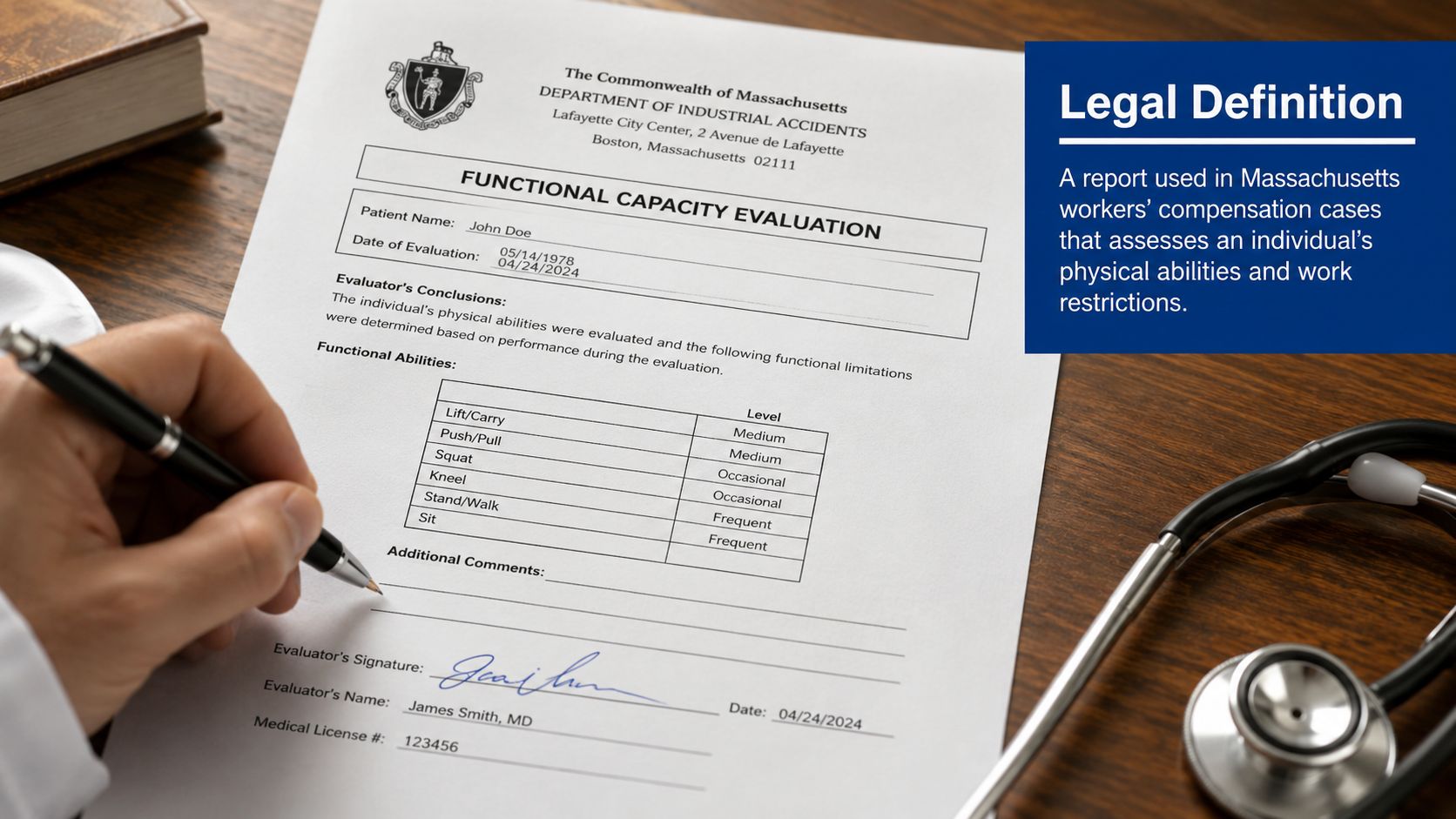
Partial disability in Massachusetts workers' compensation is a functional-capacity finding, not just a diagnosis on a chart. Cornell's legal definition says it exists when an employee cannot return to the position held at the time of injury, or earn equivalent wages, because of the work-related injury, yet is not totally disabled for all gainful employment. Cornell partial disability definition
What the insurer looks for
The insurer usually asks three questions at once. Can the worker do the pre-injury job at full capacity? Can the worker earn the same wage in a different role? Are the medical restrictions tied to the work injury and not to some unrelated condition?
That is why the medical record matters so much. A doctor's restriction on lifting, standing, overhead work, repetitive motion, or schedule length is often the starting point. Then the job description has to be matched against those restrictions. If the worker cannot perform the material duties of the old job, or only can do them with reduced hours or lower pay, the file starts looking like a partial disability case.
Practical rule: the issue is not whether the worker can do something. The issue is whether the worker can do the same job, the same hours, for the same money.
Partial disability also sits on a spectrum of work capacity. Cornell's Wex notes that physicians may classify partial disability when about 25% to 50% of physical or mental capability is affected. That range is not a magic number for every case, but it shows how this area of law focuses on lost function in a work context rather than on the presence of injury alone.
A worker with knee damage, nerve problems, hearing loss, vision loss in one eye, or PTSD may all fall into partial disability territory if the condition reduces occupational performance enough to create wage loss or duty restrictions. The best evidence is usually the combination of physician restrictions, job-duty analysis, wage records, and proof that the wage loss traces back to the injury.
For a closer look at how legal strategy develops when benefits are threatened, Shea Culgin Law's discussion of permanent total disability benefits helps frame the opposite end of the disability spectrum.
Partial Disability Versus Total Disability
Total disability means the worker cannot do meaningful work in a way that produces reliable earnings. Partial disability means some work is still possible, but not at the pre-injury level of function or pay. The distinction sounds clean on paper, but insurers fight over it because the classification affects what gets paid and how long the dispute lasts.
Side by side comparison
| Factor | Partial Disability | Total Disability |
|---|---|---|
| Work ability | Some work is still possible, usually with restrictions | No meaningful work capacity |
| Earnings | Reduced pay or reduced hours are common | No realistic earning capacity from work |
| Medical picture | Restrictions still allow limited function | Restrictions are so severe that work is not practical |
| Claim focus | Wage loss and work-capacity loss | Full inability to work |
| Common dispute | Whether equivalent wages are still available | Whether the worker can do any gainful work at all |
A worker can be capable of some work and still be financially crushed. That is the hard part insurers sometimes gloss over. A changed schedule, a lighter job title, or a modified assignment does not automatically eliminate wage loss, and wage loss is exactly what partial disability is designed to address.
The classification can also change with the evidence. A doctor may say a worker can return with restrictions, while a vocational reviewer argues that other jobs exist at the same wage. That fight is where the claim often lives or dies. The insurer is usually looking for a path to say the worker is not totally disabled, but also not entitled to full partial benefits for as long as claimed.
In practice, this is why workers should not treat a return-to-work notice as a final answer. The same injury can support a partial disability claim if it cuts earnings, but it may not support a total disability claim if some work is still feasible. The law cares about the actual labor picture, not just the label on the medical report.
Calculating Partial Disability Benefits in Massachusetts
A partial disability claim often comes down to simple wage math, but the dispute is usually over what caused the drop in pay. A worker may come back to a job, take lighter duty, and still lose income because the new assignment pays less, the schedule shrinks, or overtime disappears. In practice, that lost earnings picture is what the partial disability analysis has to measure.
According to the National Council on Compensation Insurance (NCCI) guidelines, partial disability policies often turn on a loss of earnings, hours, or the ability to perform a defined share of material duties, and older policies may require a 15% to 20% income-loss threshold before partial benefits begin. Partial disability benefit thresholds
How the wage-loss math usually works
The starting point is usually the worker's pre-injury pay and the post-injury pay. If a Massachusetts worker earned full wages before the injury and later returns on modified duty at a lower rate, the claim focuses on how much of that gap the workers' compensation system should replace. The exact benefit calculation depends on the benefit type and when the worker returned, but the core question stays the same, whether the injury caused the earnings drop.
A practical example shows how this works. A worker earned $1,200 per week before the injury. After returning to light duty, the worker earns $900 per week because the employer reduced the hours and removed overtime. That $300 weekly difference becomes the issue, and the claim rises or falls on whether the reduced earnings trace back to the medical restrictions and the work injury.
That is why payroll records matter so much. Pay stubs, time sheets, work schedules, and written light-duty offers show whether the loss came from injury-related limits or from some unrelated reason. If the insurer says the worker chose fewer hours, the file needs proof that the doctor restricted the schedule or that the old duties could not be done safely.
Best evidence usually beats best arguments. Medical restrictions, actual payroll records, and the written return-to-work offer usually tell the real story faster than any letter from a claims adjuster.
Workers also need to separate lower hourly pay from fewer hours, because the source of the loss affects how the claim is presented. Both can support a wage-loss claim if the change flows from the injury. A clean earnings history before and after the accident often becomes one of the strongest parts of the file.
A return-to-work dispute can also turn on whether the worker is being offered work at the same value. An employer may say the position is “available,” but if the pay, hours, or overtime structure has changed, that does not erase the loss. The practical question is whether the worker can earn the same money in the job market, not whether a modified desk exists on paper.
If social media starts to show up in the file, the worker needs to be careful. A short post about carrying groceries, helping at a kids' game, or doing a side project can be used against the claim, even when it does not reflect full work capacity. How social media can be used in a Brockton workers' comp claim
Why Insurers Dispute Partial Disability Claims
Insurers rarely come out and say a worker has no injury. They usually take a narrower position. They argue that the worker can still earn the same money somewhere else, that the wage loss came from something other than the injury, or that the doctor's limits are broader than the insurer thinks the file supports. Those disputes are common because partial disability claims sit at the point where medical restrictions, job duties, and lost wages all have to line up.
Insurers also know that partial disability is often fought on the numbers, not on sympathy. They will look for any gap between the treating doctor's limits and the actual work offered, then try to use that gap to cut off benefits. If the worker's earnings changed for reasons outside the injury, the carrier will push that point hard and treat it as a reason to deny or reduce the claim. That is why wage-loss disputes are rarely settled by one document alone.
The usual pressure points
A frequent tactic is to send the worker to an independent medical exam and then use that report to argue the restrictions are lighter than the treating physician says. The insurer may also order a vocational review or labor market survey to say suitable work exists at the same wage. Once those reports enter the file, the fight shifts fast. The issue becomes whether the worker's injury reduced earning capacity, or whether the carrier can frame the loss as temporary, self-imposed, or unrelated.
The employer side often tries to recast the dispute around the job offer itself. A modified position may be described as available and appropriate, but the key question is whether it restores the worker to the same earning level in practice. If the schedule is shorter, overtime disappears, or the new duties are less valuable in the labor market, the insurer will still argue that the pay difference does not belong to the claim. That is why the wage analysis matters just as much as the medical paperwork.
Social media can add another layer of trouble. A brief post about carrying groceries, attending a child's game, or helping with a side project can be used to attack the claimed restrictions, even if the post says nothing about full-time work. The point is not that every online post hurts a case. The point is that casual public activity can be read by an insurer as proof that the worker is more capable than the medical records show, and that is often enough to trigger a denial or a surveillance request. how social media can be used in a Brockton workers' comp claim
The practical response is to keep the story consistent before the claim gets challenged. When the treating notes, the employer's offer, and the wage records point in different directions, the insurer will exploit the inconsistency and argue that the loss is not tied to the injury. Workers also need to be careful about offhand statements to adjusters, supervisors, or coworkers, because those comments often show up later in the claim file and get used to minimize the benefits.
Partial disability claims usually go sideways when the record leaves room for that kind of argument. They also become harder to defend when the worker accepts modified work but never documents how the new role changes the paycheck, the hours, or the opportunity to earn overtime. At that point, the insurer gets to describe the reduced income as a business choice instead of an injury consequence, and that is the version of events the worker has to be ready to challenge.
A Real-World Massachusetts Partial Disability Scenario
A construction worker injures a knee on the job and reports it right away. The treating doctor limits climbing, kneeling, and heavy lifting, then clears the worker for modified duty. The employer offers a lighter assignment, but the schedule is shorter and the pay drops.

How the case unfolds
The worker keeps working because bills do not pause. But the new role is not the old job, and the paycheck proves it. The partial disability issue is no longer theoretical, because the injury has changed the worker's earning pattern.
The insurer then asks for more information. It wants the treating notes, the actual job offer, and the wage records before and after the injury. If the worker's reduced earnings line up with the doctor's limits, the claim becomes much harder to dismiss.
That is where the difference between medical status and wage-loss status becomes obvious. A worker can be cleared for some work and still have a legitimate claim because the modified role does not restore pre-injury earning power. Partial disability is not a consolation prize. It is the law's way of recognizing that returning to work and returning to the old income are not the same thing.
This is also where employers sometimes misread the situation. A light-duty assignment can look like a favor from management, but if the assignment only exists because of injury-related restrictions, the wage loss can still belong in the workers' compensation system. The issue is not whether the worker is doing something. The issue is whether the worker is back to earning the same livelihood.
In a case like this, the timeline matters as much as the injury itself. Report, restrictions, modified work, wage drop, and insurer response all have to line up. When they do, partial disability becomes a factual claim, not a guess.
Protecting Your Claim and Getting the Right Help
The safest partial disability claims are the ones built on clean records. Keep every doctor note, every return-to-work slip, every schedule change, and every pay stub. If the employer changes the job again, get that in writing too.
A worker should also be careful with communications. Short, factual updates are better than long explanations, and social media should be treated like evidence, because it can be. If the insurer says the worker can do more than the doctor allowed, the response should come from records and medical support, not from improvisation.
When the insurer cuts benefits, disputes wage loss, or pushes a return-to-work plan that does not match the restrictions, legal help can matter fast. A Massachusetts workers' compensation attorney can review the wage math, push back on improper denials, and handle hearings or settlement talks when the file stops moving fairly. Shea Culgin Law is one option for that kind of case evaluation in Massachusetts.
If the paycheck is lower because the injury changed the job, don't wait for the insurer to define the case for you. Gather the records, document the restrictions, and get a Massachusetts workers' compensation review before a small wage issue turns into a long benefit fight.
Produced via Outrank