





A driver's bumper catches a pedestrian in a Brockton crosswalk, and the next few minutes become a blur of pain, traffic, sirens, and strangers asking what happened. By the time the injured person reaches an emergency department, the driver's insurer may already be treating the event as a claim to control rather than a person's life turned upside down.
A pedestrian vehicle accident can cause fractures, brain injuries, spinal damage, emotional trauma, and months of lost work even when the victim survives. In the United States, 71,635 pedestrians were injured in 2024, compared with 7,080 deaths, and pedestrian injuries rose while deaths fell that year, according to 2024 pedestrian injury and fatality data. Those nonfatal cases create many of the hardest disputes over treatment, disability, medical expenses, and fair settlement value.
Massachusetts law also creates practical decisions that shouldn't be postponed. Evidence disappears, witnesses become difficult to locate, and casual statements can become insurer exhibits. The steps below focus on what an injured pedestrian and family members should do before the claim gets defined by someone else.
Table of Contents
- The First Moments After a Pedestrian Vehicle Accident
- How Fault Is Determined in Massachusetts Pedestrian Collisions
- Common Injuries and Why Nonfatal Outcomes Matter
- Evidence Collection Checklist for the First 72 Hours
- How Insurers Try to Minimize Pedestrian Claims
- Settling on Your Own vs Hiring a Massachusetts Injury Attorney
- Your Next Steps After a Pedestrian Vehicle Accident
The First Moments After a Pedestrian Vehicle Accident
A pedestrian crossing a busy street in Brockton may have the right of way, yet the immediate aftermath rarely feels orderly. The person may be on the pavement, unable to tell whether the pain comes from a broken bone, a head injury, or shock. The driver may be standing nearby, a bystander may be filming, and someone may already be calling 911.
The first priority is safety and emergency care. The injured pedestrian shouldn't refuse an ambulance because the pain seems manageable. Adrenaline can mask symptoms, and a concussion, internal injury, fracture, or soft-tissue injury may become clearer only after the initial shock fades.
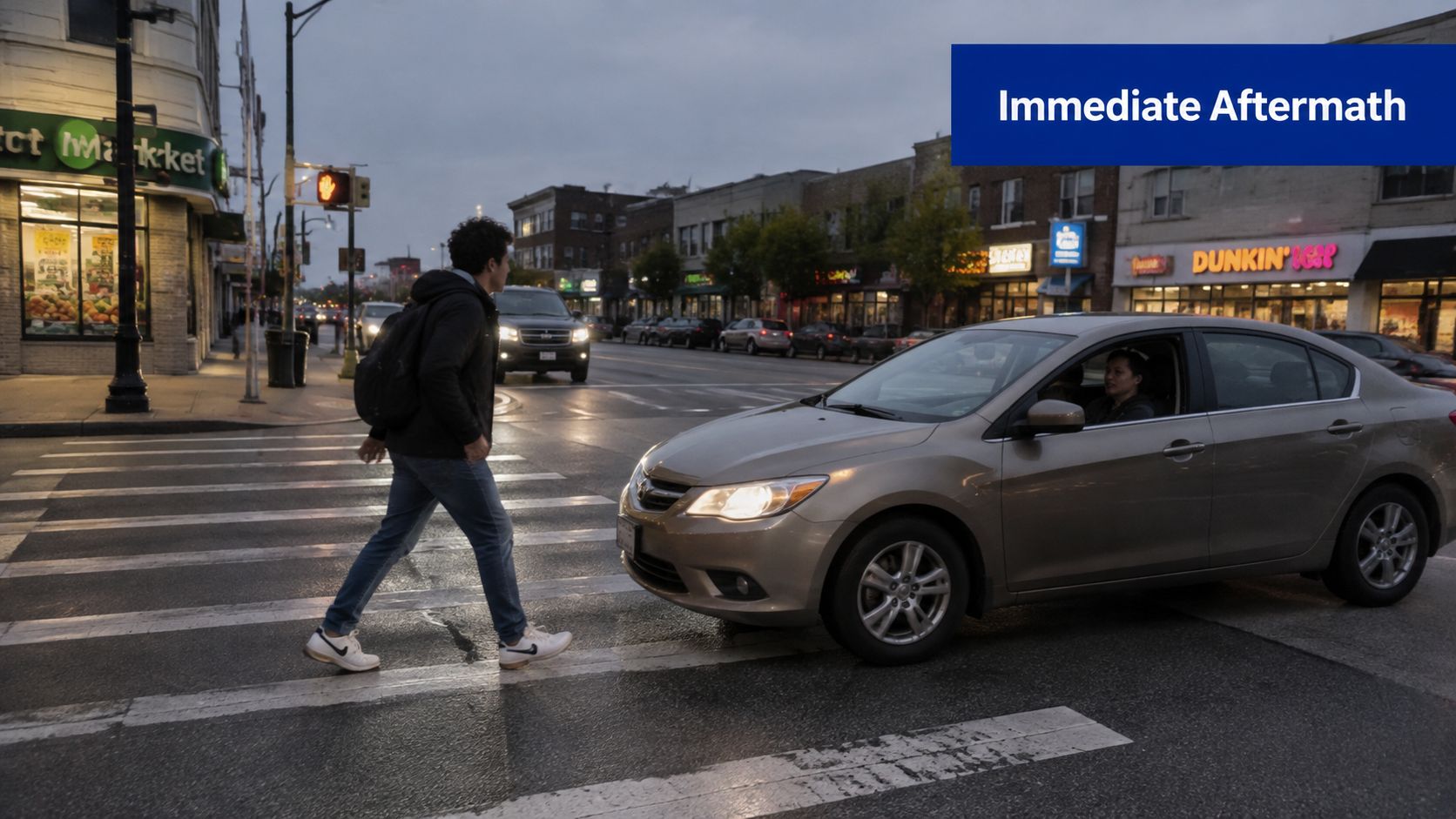
What to do before leaving the scene
If medical personnel can safely permit it, the pedestrian or a family member should preserve basic details:
- Identify the location: Record the street, direction of travel, crosswalk, traffic signal, lane position, and nearby businesses.
- Find witnesses: Obtain names and contact information from people who saw the impact, the traffic signal, or the driver's approach.
- Photograph the surroundings: Crosswalk markings, signal heads, lighting, sight lines, vehicle position, debris, and visible injuries may matter more than a close-up of bumper damage.
- Note the police response: Keep the incident number and request the report when it becomes available.
The injured person shouldn't argue with the driver or try to negotiate payment at the curb. Even a statement such as “I didn't see the car” can be taken out of context later. The driver's insurer isn't a neutral investigator, so a request for a recorded statement should be declined until the pedestrian has received legal advice.
The first 24 to 72 hours also matter because medical records establish timing and symptoms. A person who waits while hoping a sore neck or headache will disappear may later face an insurer arguing that the condition came from something else. Prompt care doesn't guarantee a claim, but delayed care gives the insurer an avoidable argument.
Practical rule: Seek appropriate medical attention, preserve what can be preserved, and don't give the opposing insurer a recorded statement before receiving advice.
A family member can help by saving clothing, shoes, photographs, discharge paperwork, prescriptions, and appointment information. If the driver fled, the family should also review guidance on Massachusetts pedestrian hit-and-run claims promptly, because locating video and witnesses becomes more urgent when the vehicle isn't identified.
How Fault Is Determined in Massachusetts Pedestrian Collisions
Massachusetts does not decide every pedestrian collision by asking only whether the driver struck the person. The investigation examines what each participant did, what each could see, the traffic controls, road conditions, vehicle movement, and whether another person or entity contributed to the event.
The state uses a modified comparative negligence framework. A pedestrian may recover when the pedestrian's share of fault is less than 51%, but the award is reduced by the percentage assigned to that pedestrian. A person who is accused of crossing outside a marked area, looking at a phone, or entering traffic unexpectedly shouldn't assume the accusation ends the case. Fault is a factual question, and the insurer's first version is not a court ruling.
Massachusetts claim path (PIP and the tort threshold): pedestrians struck by insured vehicles may access Personal Injury Protection benefits under the coverage rules in G.L. c. 90, § 34A (and related PIP provisions). A separate bodily-injury claim for pain and suffering generally must satisfy G.L. c. 231, § 6D—typically medical expenses over $2,000 as coordinated with PIP, or a listed serious injury. Comparative negligence under G.L. c. 231, § 85 can still reduce or bar recovery. None of these rules assigns a settlement dollar value to a pedestrian case.
The defenses insurers commonly raise
A driver may say the pedestrian was jaywalking, appeared suddenly, or ignored a signal. Those defenses can matter, but they require proof. A crosswalk photograph, signal sequence, witness account, traffic-camera recording, or nearby business video may show that the pedestrian had entered lawfully or that the driver had enough time to react.
The driver may also claim that the pedestrian was distracted. Distraction doesn't automatically excuse speeding, failing to yield, turning without checking, or failing to maintain a proper lookout. The relevant question is how the collision occurred and whether the driver's conduct helped cause it.
Evidence should be assessed as a whole:
| Evidence | What it may clarify |
|---|---|
| Police report | Initial accounts, roadway location, citations, and observed conditions |
| Witness statements | Signal status, vehicle speed, pedestrian movement, and driver behavior |
| Traffic or business video | Timing, right of way, turning path, and whether the driver stopped |
| Vehicle data and damage | Direction of impact and consistency with the competing accounts |
| Medical records | Timing, mechanism, symptoms, and treatment progression |
A police report is useful, but it isn't the final word. Officers often arrive after vehicles move, witnesses leave, and the injured person is transported. An attorney may need to locate additional video, inspect the intersection, identify sight-line problems, and compare the physical evidence with the statements.
For a practical discussion of representation, injured pedestrians can review a Massachusetts pedestrian accident lawyer resource. The central point is simple: being partly blamed doesn't mean the pedestrian should abandon a potentially valid claim. It means the evidence and the percentage allocation need careful analysis.
Common Injuries and Why Nonfatal Outcomes Matter
A pedestrian may leave the scene alive yet face months of treatment, lost income, and limitations that an insurer tries to label temporary or unrelated. Nonfatal cases create a difficult proof problem. The injured person must explain symptoms, treatment barriers, and changes in daily life while the insurance company looks for gaps it can use to reduce the claim.
The injuries vary widely. Fractures may require surgery, immobilization, rehabilitation, and time away from work. A traumatic brain injury can affect concentration, memory, balance, mood, and tolerance for noise or light. Spinal injuries may limit lifting, sitting, standing, or driving. Soft-tissue injuries can disrupt sleep and ordinary movement even when imaging shows no dramatic structural damage.
Symptoms may develop after the impact
Whiplash, concussion symptoms, nerve pain, and emotional distress may become clearer after the collision. Someone who initially says they feel fine may later develop headaches, dizziness, neck pain, anxiety, nightmares, or difficulty returning to routine activities. Later symptoms still require a medical explanation, so prompt follow-up and accurate reporting matter.
Psychological injuries also affect a claim. Fear of crossing streets, panic in traffic, depression, and post-traumatic stress can interfere with work and family life. A record containing only an emergency-room visit gives an insurer room to argue that the condition resolved. Delayed treatment can create the same problem, even when pain or cognitive symptoms were initially difficult to recognize.
Social media creates another hidden risk. A photograph showing a walk, family activity, or apparently normal day may be presented as evidence that the injury is minor. Recorded statements can create similar difficulties if the injured person minimizes symptoms, guesses about recovery, or gives an incomplete account before understanding the diagnosis.
The nonfatal gap is substantial. Federal transportation data cited above recorded 71,635 injured pedestrians and 7,080 killed pedestrians, with injuries rising 5.0% while deaths fell 3.9%. A pedestrian claim therefore requires attention to lasting impairments, not only fatal-crash headlines.
Building a reliable medical record
Tell every provider about all symptoms, including those that seem less serious. Records should connect complaints to functional effects, such as difficulty climbing stairs, missed shifts, household assistance, or an inability to drive.
A useful record includes:
- The initial evaluation: Symptoms, visible injuries, testing, and discharge instructions.
- Follow-up care: Therapy, specialist visits, medication changes, and continuing complaints.
- Work restrictions: Missed time, modified duties, and the medical basis for those limits.
- Daily impact: Sleep disruption, household help, transportation problems, and emotional effects.
Insurers may treat recovery as complete once a person looks mobile in a photograph. Medical documentation provides a more accurate timeline. Guidance on traumatic brain injury claims in Massachusetts explains why symptoms that are not immediately visible still require careful proof.

Evidence Collection Checklist for the First 72 Hours
A pedestrian may be too injured to gather evidence personally. A spouse, adult child, friend, or attorney can handle much of the preservation work while the victim focuses on treatment.
At the scene
- Call emergency services and remain available to officers. The police report can identify the parties, location, and initial observations, but the injured person's own account should be accurate and concise.
- Photograph the intersection if safe. Include the crosswalk paint, signal, curb, lighting, lane markings, parked vehicles, obstructions, and the driver's vehicle. A photograph showing sight lines can be more valuable than a close-up of damage.
- Collect witness information. Witnesses may remember the traffic signal, whether the vehicle accelerated or turned, and whether the driver stopped. Their names and contact details are more useful than relying on an unidentified social-media video.
- Preserve clothing and personal items. Don't wash or discard torn clothing, damaged shoes, a backpack, glasses, or a phone involved in the event. Store them in a clean, dry place.
Within the first day
Medical care comes before claim administration. The pedestrian should follow discharge instructions, report worsening symptoms, and keep a simple symptom log that records pain, dizziness, sleep, mobility, and missed activities.
The family should create one folder for police paperwork, medical records, prescriptions, bills, employer communications, photographs, and insurance letters. Dates matter, especially when the insurer later suggests that treatment was sporadic or unrelated.
Before the third day passes
Ask nearby businesses, residences, transit facilities, and municipal offices whether cameras may have captured the collision. Video systems often overwrite footage, and a polite request may not preserve it. A lawyer can send preservation letters and pursue records through the appropriate process.
Don't post photographs, check-ins, arguments, or recovery updates on social media. An image of the injured person standing at a family gathering can be presented as proof that the person wasn't seriously hurt, even if the photograph captures only a brief moment.
Evidence often disappears before a claim is formally evaluated. Early preservation protects the facts that later arguments depend on.
The driver's insurer may request a recorded statement. The pedestrian should obtain the adjuster's name and claim number, then avoid discussing fault, speed, symptoms, or prior injuries without advice. The same caution applies to signing a broad medical authorization or accepting an early release.
How Insurers Try to Minimize Pedestrian Claims
An adjuster may sound sympathetic while building a defense. The insurer's job is to control its financial exposure, and the first conversation can become part of that effort.
The most common tactic is to define the accident narrowly. The adjuster may focus on whether the pedestrian wore dark clothing, crossed outside the painted lines, or looked away, while ignoring signal timing, vehicle speed, turning behavior, lighting, and the driver's duty to maintain a proper lookout.
The recorded statement trap
A recorded statement creates a permanent version of events before the injured person understands the medical and legal significance of every detail. Shock can produce uncertainty about timing, direction, or the exact moment of impact. Later clarification may be portrayed as inconsistency.
The adjuster may also ask about prior injuries or medical history in a way that encourages broad answers. Relevant medical information may matter, but an unrestricted authorization can expose records unrelated to the collision and give the insurer material for arguments about causation.
Downplaying nonfatal injuries
Because the pedestrian survived, an insurer may characterize the claim as a short-term inconvenience. It may point to normal imaging, a gap in therapy, a return to work, or a social-media photograph without examining whether the person returned with restrictions or continued to experience pain.
The insurer may delay responding, request repetitive documentation, or make an early offer before the medical picture is stable. That offer can look helpful when bills are arriving, but accepting it may end the claim before future treatment and disability are understood.
A settlement release is not a routine receipt. It can permanently close claims for symptoms that haven't fully appeared.
Social media creates another hidden risk. Posts about exercise, travel, work, family events, or ordinary activities may be stripped of context and used to challenge the claimed limitations. Privacy settings don't guarantee protection, and deleting content after a collision can create a separate credibility problem.
Early legal involvement changes the communication channel. An attorney can investigate fault, organize medical proof, respond to insurer requests, and identify when negotiation has become pressure rather than a fair evaluation.
Settling on Your Own vs Hiring a Massachusetts Injury Attorney
Direct settlement can be reasonable in a minor claim. A pedestrian with limited symptoms, a single evaluation, no ongoing treatment, no missed work, clear fault, and no anticipated complications may prefer to handle communication personally. That choice still requires reading every release carefully and understanding that an insurer's offer may include all available compensation.
The calculation changes when the injury has a continuing effect. A pedestrian should be cautious about self-settlement when:
- Treatment continues: Therapy, specialists, injections, surgery discussions, or neurological follow-up suggest the claim isn't fully known.
- Fault is disputed: The insurer says the pedestrian caused or substantially contributed to the collision.
- Work has changed: Missed shifts, reduced duties, lost opportunities, or an uncertain return date create valuation issues.
- The insurer is rushing: Repeated calls, recorded-statement requests, or an early release request deserve legal review.
- The symptoms are invisible: Brain injury, nerve pain, chronic pain, and psychological trauma require more than a quick bill total.
An attorney doesn't eliminate uncertainty. Legal fees reduce the eventual recovery, and a case may take time, require cooperation, and involve uncomfortable questions about medical history and daily limitations. Those are real trade-offs.
What representation changes
A lawyer can manage insurer communications, investigate surveillance and traffic evidence, obtain records, assess comparative negligence, and calculate damages beyond immediate medical bills. Representation also gives the injured person a buffer from the adjuster while treatment continues.
Contingency representation generally means the attorney's fee is tied to the recovery rather than paid upfront, but the client should ask about the percentage, litigation expenses, medical liens, and what happens if there is no recovery. The written agreement controls.
Shea Culgin Law is one Massachusetts option that handles pedestrian injury claims, coordinates with insurers and opposing counsel, and evaluates matters through negotiation, settlement, or litigation. The firm should be compared with other counsel based on communication, experience with disputed pedestrian cases, fee terms, and the specific facts of the collision.
The practical decision is not whether every pedestrian needs a lawyer. It is whether the person can confidently value an unresolved injury, preserve evidence, resist insurer tactics, and pursue the claim while recovering. If not, a consultation before signing anything can prevent an avoidable mistake.
Your Next Steps After a Pedestrian Vehicle Accident
The immediate plan is straightforward:
- Get medical care and follow up. Report every symptom and limitation, including headaches, dizziness, pain, sleep changes, anxiety, and difficulty working.
- Preserve evidence. Save clothing, photographs, witness details, police information, medical records, bills, and employer communications.
- Protect communications. Don't give a recorded statement, sign a broad release, or discuss the collision on social media without legal advice.
- Investigate quickly. Traffic footage and business surveillance may not remain available, so a family member or attorney should act promptly.
- Review settlement terms before accepting money. An early check may come with a release that ends rights to future compensation.
A consultation should address fault, Massachusetts comparative negligence, available insurance, medical treatment, lost income, evidence preservation, and the likely decision points in the claim. The injured person doesn't need to have every record organized before seeking advice.
The collision may have left the pedestrian frightened, frustrated, and unsure how household expenses will be managed. Those feelings are common, but the insurer's urgency shouldn't dictate the claim's value.
If a pedestrian or loved one was injured in Massachusetts, contact Shea Culgin Law today for a case evaluation before giving a recorded statement or accepting a settlement. Gather the police information, medical paperwork, photographs, and insurer correspondence if available, and discuss the claim with a Massachusetts injury attorney who can help protect the evidence and determine the next practical step.