





You're halfway through an intersection when a driver turns across the bike lane. The impact may last less than a second. The driver checks a dented bumper and speaks with police from inside the vehicle. The cyclist checks for blood, tries to stand, and may not yet realize that a concussion, broken collarbone, or internal injury has begun to develop.
That unequal physical exposure creates unequal legal and financial problems. Car vs bike accidents require more than asking who hit whom. The important questions include who had the right of way, how each person moved, what the evidence shows, which insurance policies apply, and whether the cyclist's injuries will affect work and daily life.
Table of Contents
- What a Car vs Bike Accident Really Looks Like
- How Often These Crashes Happen and Who They Kill
- Injury Profiles of Drivers Versus Cyclists
- Liability and Fault Rules in Massachusetts
- Insurance Asymmetry Between Drivers and Cyclists
- What a Cyclist's Claim Actually Looks Like
- When to Handle It Yourself and When to Hire a Lawyer
- Common Misconceptions That Hurt Cyclist Claims
What a Car vs Bike Accident Really Looks Like
At a signalized Massachusetts intersection, a cyclist proceeds straight through a green light. A driver approaching from the opposite direction begins a left turn. The driver looks for a gap in oncoming traffic, but fails to see the cyclist until the vehicle's front corner enters the cyclist's path.
The bicycle stops almost instantly. The rider does not. A shoulder or hip may strike the hood, followed by a fall onto pavement. The driver may experience a seatbelt pull, airbag deployment, or no physical injury at all. The cyclist may be disoriented, bleeding, or unable to move an arm.
The first ten minutes matter
The cyclist's first decisions are medical, not strategic. If movement is safe, the rider should get out of active traffic, call 911, and ask for medical evaluation. If severe pain, neck or back symptoms, confusion, or loss of consciousness is present, the cyclist shouldn't attempt to “walk it off.”
The driver should remain at the scene, provide identification and insurance information, and avoid arguing about fault. A driver's casual statement such as “I didn't see the bike” may later become important, but the cyclist shouldn't try to conduct an interrogation while injured.
Police typically document the roadway, traffic controls, vehicle damage, bicycle damage, statements, witnesses, and apparent injuries. That report matters, but it isn't the final word on liability. Officers may arrive after vehicles move, witnesses may disagree, and a report may omit camera footage or later medical findings.
Practical rule: The scene should be treated as evidence, not as a place to negotiate a settlement.
Why the same crash creates different claims
The driver's claim usually concerns vehicle damage, possible personal injury, and liability exposure. The cyclist's claim can include emergency care, continuing treatment, lost income, damaged equipment, pain, reduced mobility, and the effect of the injury on ordinary activities.
Speed and angle often matter more than the visible damage to the car. A minor dent can coexist with a serious cyclist injury because the rider absorbs the collision directly and then may strike the road. That is why a quick exchange of information followed by no medical record can leave an injured cyclist with a weak claim, even when the driver clearly caused the impact.
How Often These Crashes Happen and Who They Kill
A cyclist can survive a car collision with fractures, a head injury, chronic pain, or reduced earning capacity. Fatality tables capture only the most severe outcome, not the much larger group of injured riders whose crashes still produce medical bills and legal claims.
In the United States, NHTSA reports that bicyclist deaths ranged from 623 in 2010 to a peak of 966 in 2021. The five-year average was 883 deaths per year from 2017 through 2021, and bicyclists represented 2.2% of all traffic fatalities in 2021, according to NHTSA's bicycle safety countermeasures data.
The federal figures remained high afterward. NHTSA reports 1,105 bicyclists killed in motor-vehicle traffic crashes in 2022 and 1,166 pedalcyclist fatalities in 2023. Pedalcyclists accounted for 2.9% of all traffic fatalities in 2023.
A cross-border severity snapshot
| Indicator | Value | Source region |
|---|---|---|
| Bicyclist deaths in 2010 | 623 | United States |
| Peak bicyclist deaths in 2021 | 966 | United States |
| Five-year average, 2017 to 2021 | 883 deaths per year | United States |
| Bicyclist deaths in 2022 | 1,105 | United States |
| Pedalcyclist fatalities in 2023 | 1,166, 2.9% of traffic fatalities | United States |
| Pedal cyclists killed in 2024 | 82 | Great Britain |
| Serious pedal-cycle injuries in 2024 | 3,822 | Great Britain |
| Slight pedal-cycle injuries in 2024 | 10,645 | Great Britain |
The Great Britain figures show how often passenger cars are involved in fatal bicycle collisions. Between 2020 and 2024, almost half of pedal-cycle fatalities occurred in two-vehicle collisions involving a bicycle and a car. 231 cyclist fatalities involved a car, according to the 2024 Great Britain pedal-cycle factsheet. The same factsheet records 82 pedal cyclists killed, 3,822 seriously injured, and 10,645 slightly injured in 2024.
Fatality data leave out many injured cyclists
Police records do not capture every cycling injury. Reporting becomes less complete as injury severity decreases, and cyclist-only falls or slips are particularly likely to go unrecorded. A rider may also reach an emergency room after a traffic collision without a police investigation appearing in the official data.
That gap matters when evaluating a Massachusetts claim. A nonfatal collision does not become legally minor because it is absent from a national safety table. The claim turns on medical continuity, documented causation, lost income, and proof of the driver's responsibility. Fatal crashes drive headlines, while underreported survivable collisions often determine the volume and value of actual injury claims.
Injury Profiles of Drivers Versus Cyclists
A passenger car gives its occupant a steel structure, seatbelt, airbags, and a fixed seating position. A bicycle provides none of those barriers. In a collision, the cyclist may strike the vehicle's front, roll over the hood, hit the pavement, or be struck by another road user.
The driver may suffer belt-related chest soreness, wrist or arm injuries from the steering wheel, airbag abrasions, knee injuries, or delayed neck and back symptoms. Those injuries can support a claim, but the passenger compartment usually separates the driver from the first impact. The cyclist remains exposed through the entire sequence.
Cyclists face direct and secondary impacts
Cyclist injuries commonly involve the head, face, clavicle, ribs, pelvis, and extremities. Even limited vehicle contact can be followed by a hard fall, making the road surface a second impact point. Abrasions, fractures, and soft-tissue injuries may result from that fall rather than from the vehicle's initial contact.
Medical records should describe the mechanism of injury, not merely list symptoms. “Shoulder pain” carries more weight when the records connect restricted movement and imaging findings to the collision and fall. Anyone recovering from a motor-vehicle collision can review what to expect physically after a car accident, although a bicycle crash often involves more exposed contact with both the vehicle and pavement.
Vehicle design changes the risk
Taller vehicles, including SUVs, pickups, and vans, can create a different injury sequence from a conventional passenger car. Hood height and front-end geometry affect where the cyclist is struck and how the body moves afterward. The vehicle type does not establish fault by itself, but it can help explain the severity and pattern of injury.
A low-speed collision with a lower front end may produce a different sequence from one involving a taller front end. Attorneys and medical providers should examine the vehicle type, point of contact, rider position, road surface, and fall path. Those details matter both for treatment and for evaluating causation and claim value. Treating every vehicle as physically identical obscures the evidence that can change the outcome.
Liability and Fault Rules in Massachusetts
Massachusetts generally treats a bicycle as a vehicle for traffic-law purposes. A cyclist has duties to operate safely and obey applicable traffic controls, while drivers owe cyclists the same basic duty of reasonable care owed to other lawful road users.
The initial question is negligence. Did the driver fail to keep a proper lookout, yield, signal, control speed, or maintain a safe distance? Did the cyclist enter against a signal, travel unpredictably, ignore a traffic control, or create an avoidable hazard? The answer comes from evidence, not from the fact that one party was driving a larger vehicle.
Massachusetts rules can change the analysis
Massachusetts law allows a cyclist, where the statutory conditions apply, to treat a stop sign as a yield sign rather than make a complete stop. That rule doesn't authorize a cyclist to enter against conflicting traffic or disregard a clear safety hazard. The precise intersection, sign, visibility, and traffic conditions still matter.
Comparative negligence then assigns responsibility between the parties. Massachusetts follows a 51% bar, meaning an injured person who is found more than half responsible generally can't recover damages. A cyclist found partly responsible but not over that threshold may recover, with damages reduced by the assigned share of fault.
The strongest claim is usually the one that proves movement, visibility, and right of way with independent evidence.
Evidence decides the percentages
Police reports help establish the initial record, but they shouldn't be treated as conclusive. A report may identify a citation, diagram, or statement, while later evidence may reveal a traffic-camera view, doorbell recording, helmet camera file, or witness who saw the signal phase.
Useful evidence includes:
- Intersection video: Traffic cameras, business footage, and residential doorbell systems may show signal timing and vehicle movement.
- Witness accounts: Independent witnesses can clarify whether the cyclist was visible and whether the driver turned across a lawful path.
- Damage patterns: Paint transfer, broken components, and vehicle damage can help reconstruct the point of impact.
- Digital records: A Garmin or Wahoo cycling computer, phone location history, or GoPro file may establish route and timing.
A cyclist's conduct can reduce recovery, but it doesn't erase the driver's duty. The claim turns on how the parties acted together in the seconds before impact.
Insurance Asymmetry Between Drivers and Cyclists
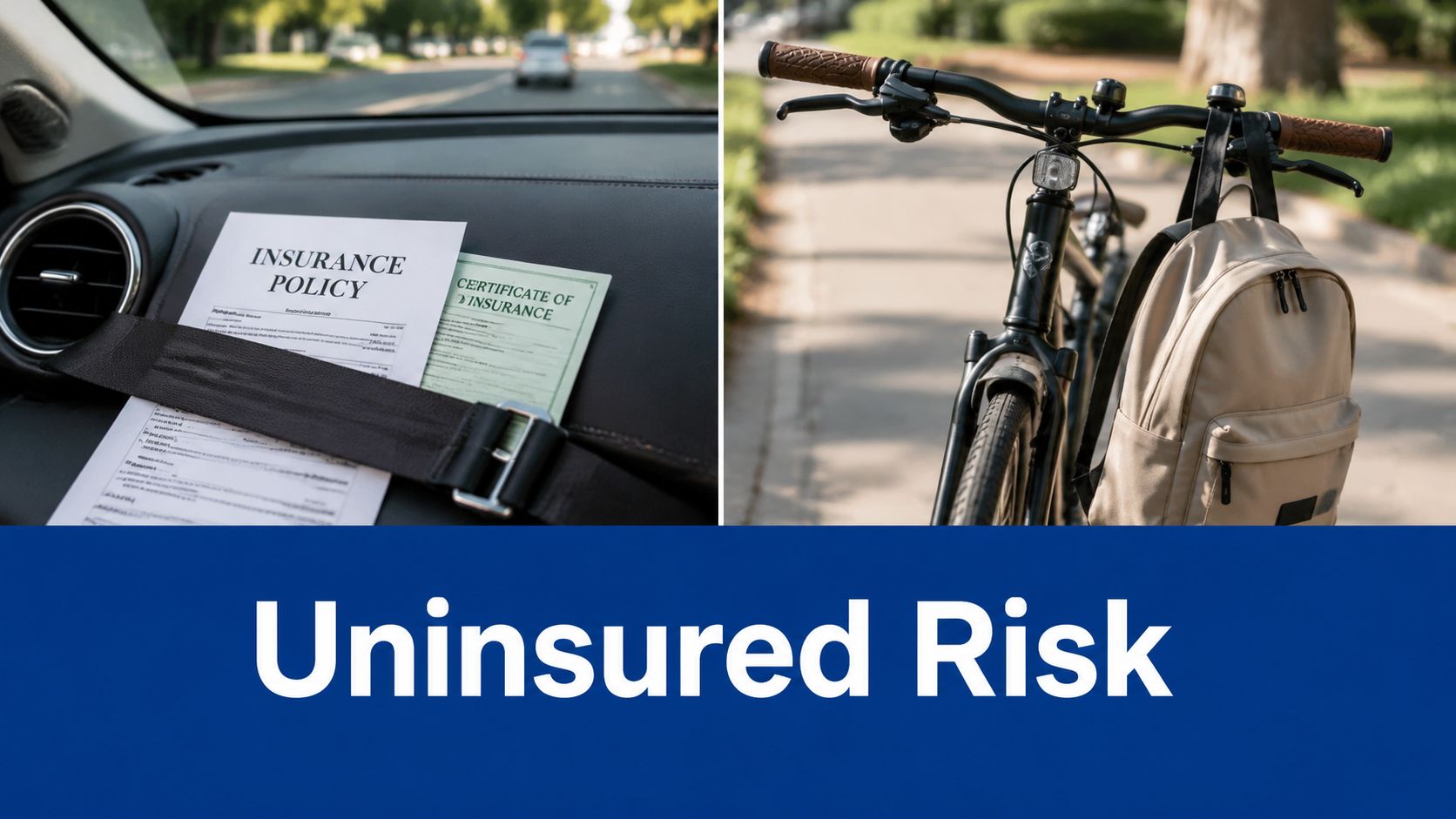
Drivers usually enter a crash with an established insurance structure. A Massachusetts automobile policy may include bodily-injury liability coverage, Personal Injury Protection, and uninsured or underinsured motorist protection. A cyclist often has no bicycle-specific liability policy and may depend on health insurance, household auto coverage, or the driver's policy.
Massachusetts PIP can help pay certain accident-related medical expenses and replacement services, subject to policy terms and eligibility. The cyclist may also have access to MedPay or uninsured and underinsured motorist coverage through a household automobile policy, even though the cyclist wasn't occupying that vehicle. The policy language and household relationship must be reviewed carefully.
The coverage stack determines practical recovery
The at-fault driver's liability limits matter because a legally strong claim can still face a collection problem when available coverage is limited and the driver has few reachable assets. A cyclist's realistic recovery may therefore involve several layers:
- Health insurance: Medical providers may bill the cyclist's health plan, with later reimbursement or lien issues.
- PIP or MedPay: Applicable first-party benefits may address immediate treatment under policy rules.
- Liability coverage: The driver's insurer evaluates fault and damages within the policy limit.
- UM or UIM coverage: A household policy may provide an additional source when the driver has no insurance or insufficient limits.
- Personal assets: This is case-specific and often less useful than insurance because collection depends on the defendant's financial position.
Insurance adjusters also distinguish between bills already incurred and future care. A cyclist with ongoing therapy, surgery recommendations, or permanent restrictions shouldn't accept a final release before the medical picture is stable.
The cyclist should identify every potentially applicable policy early. That means reviewing household auto declarations pages, asking about employer or family coverage where relevant, and preserving every insurer letter. Coverage is not a footnote. It can determine whether a claim has a meaningful recovery path.
What a Cyclist's Claim Actually Looks Like
A bicycle injury claim has two separate parts. The first proves liability, including the driver's conduct, the cyclist's conduct, and the physical mechanics of the collision. The second proves damages, including medical treatment, lost income, property damage, pain, and the effect on future activities.
A useful claim file usually contains the police report, scene photographs, vehicle and bicycle photographs, witness contacts, medical records, bills, wage documentation, and a symptom journal. The damaged bicycle shouldn't be discarded or repaired beyond what is necessary before photographs and an inspection preserve its condition.
Medical documentation drives value
The treating physician's narrative often matters more than a stack of invoices. Records should connect the symptoms to the collision, document objective findings, describe treatment recommendations, and address whether restrictions are temporary or likely to continue.
A cyclist who misses work should gather employer records, pay information, and a clear explanation of the time lost. An athlete, commuter, or parent may also have a substantial loss of enjoyment even when the claim doesn't involve permanent disability. The law recognizes more than medical bills, but the claimant still needs evidence showing how the injury changed daily life.
Insurance companies may raise helmet use, clothing, bicycle equipment, or bike-lane position as comparative-fault arguments. Those issues don't replace proof of the driver's negligence. They do affect negotiation when the evidence is unclear, so photographs, video, and prompt treatment are valuable from the beginning.
A practical claim sequence
- At the scene: Call 911, obtain medical attention, photograph the roadway, and identify witnesses.
- During early treatment: Describe every symptom accurately and follow the recommended care plan.
- While recovering: Track appointments, restrictions, missed work, medication, transportation, and daily limitations.
- Before settlement: Confirm the long-term prognosis, identify all insurance coverage, and calculate outstanding liens or reimbursement claims.
- During negotiations: Avoid recorded statements or broad medical authorizations for the opposing insurer without legal advice.
A cyclist seeking Massachusetts representation can review the firm's bicycle accident lawyer services. No settlement range can be stated responsibly without the medical records, liability evidence, available insurance, and prognosis. Moderate-looking injuries can produce very different claim values depending on those variables.
When to Handle It Yourself and When to Hire a Lawyer
A self-managed claim can make sense when the collision is minor, medical care ends after a single evaluation, symptoms resolve quickly, liability is admitted, and the insurer offers a fair payment for documented losses. The cyclist still needs to keep records and avoid signing a release until the injury has resolved.
The decision changes once treatment continues or fault becomes contested. A lawyer becomes materially more useful when the cyclist misses work, needs physical therapy, experiences headaches or cognitive symptoms, faces surgery, has a pre-existing condition the insurer may blame, or receives a settlement demand that requires a broad release.
A working decision rule
| Claim condition | Practical approach |
|---|---|
| Minor damage and resolved symptoms | Consider direct settlement after documentation |
| Continuing pain or treatment | Obtain legal advice promptly |
| Missed work or reduced earning ability | Discuss damages with counsel |
| Disputed signal, lane, or right of way | Preserve evidence and consult counsel |
| Uninsured or underinsured driver | Review all household policies |
| Permanent impairment or uncertain prognosis | Don't settle before medical clarification |
Contingency representation can improve access to counsel because the fee is generally tied to recovery, but the agreement still requires careful review. The cyclist should ask how litigation costs are handled, whether the fee changes if suit is filed, and how medical liens affect the net recovery.
The Massachusetts litigation posture is realistic when evidence supports liability and damages. Counsel can investigate, negotiate, file suit when appropriate, conduct discovery, and prepare the case for trial. A cyclist who wants a broader decision framework can read about whether to hire a personal injury lawyer or settle independently.
The practical threshold is simple. If the claim is minor and fully resolved, self-management may be efficient. If symptoms continue beyond the initial evaluation, retaining counsel quickly is usually the safer course.
Common Misconceptions That Hurt Cyclist Claims
Juries don't automatically side with drivers
Jurors may scrutinize a cyclist's conduct, but they also understand the physical consequences of a driver failing to see a visible road user. The cyclist still must prove the case with reliable evidence. A helmet-camera file, neutral witness, traffic video, or damage analysis can matter more than assumptions about public sympathy.
A missing helmet doesn't automatically eliminate recovery
Helmet use can become part of the defense, particularly when the claim includes head injury. It doesn't automatically decide whether the driver caused the collision or whether the cyclist can recover for unrelated injuries such as a broken leg, shoulder injury, or road rash. The defense still has to connect the alleged safety lapse to the claimed harm.
A bike lane isn't a complete liability answer
A bike lane supports the cyclist's position only when the lane, signal, and movement rules fit the facts. Drivers may still cross or turn across a bike lane when the law permits a maneuver, but they must do so with appropriate care. Conversely, a cyclist's presence outside the lane doesn't automatically establish fault. The roadway design, obstruction, visibility, and traffic conditions require examination.
“I'm fine” at the scene isn't a medical conclusion
Adrenaline, shock, and confusion can make an injured cyclist minimize symptoms. The statement may later appear in an adjuster's notes, but it doesn't replace a medical examination or prevent symptoms from developing. The safer response is accurate and limited: the cyclist can say that the condition is not yet clear and request evaluation.
Early medical care is both a health decision and an evidence decision.
The most damaging errors are usually avoidable:
- Delaying treatment: A gap allows the insurer to argue that the injury came from another event.
- Posting online: Cycling photos or optimistic updates can be taken out of context.
- Repairing the bike immediately: The original damage may help reconstruct the collision.
- Giving a recorded statement: Early descriptions often omit symptoms that appear later.
- Accepting a quick release: A settlement can end claims before the prognosis is known.
A cyclist doesn't need to exaggerate injuries to present a strong claim. The effective approach is precise documentation, consistent treatment, preserved evidence, and a clear account of how the collision changed work and ordinary life.
After a Massachusetts car vs bike accident, the injured cyclist should prioritize emergency care, preserve the scene evidence, identify every available insurance policy, and avoid signing a release before the medical outlook is clear. Contact Shea Culgin Law for a case evaluation if treatment continues, work has been missed, fault is disputed, or the driver's coverage appears inadequate, and bring the police report, photographs, medical records, wage information, and insurer correspondence to the consultation.