





You're riding in the back of an Uber or Lyft, or maybe you're the pedestrian who got clipped while the app was glowing on a driver's phone. The crash is over in seconds, but the confusion hangs around much longer. Who pays, whose insurance applies, and whether the driver was “on the app” can change the entire claim.
That uncertainty is why rideshare crashes aren't treated like ordinary fender-benders. Uber and Lyft complete billions of trips, yet serious harm still occurs often enough to create recurring liability and insurance disputes that need careful legal handling, and Uber recorded 153 fatal crashes while Lyft recorded 111 in 2021 to 2022 (Richman Law rideshare accident statistics). For an injured person in Massachusetts, the key is to move quickly, protect the evidence, and understand who may be responsible before an insurer tries to narrow the case.
Table of Contents
- After the Crash The First Moments of Confusion
- Should You Hire a Lawyer or Settle Yourself
- Decoding Rideshare Insurance in Massachusetts
- Preserving Critical Evidence After a Rideshare Crash
- Driver vs Company Who Is Actually Liable
- Finding the Right Rideshare Accident Lawyer in MA
After the Crash The First Moments of Confusion
The scene after a rideshare collision usually has the same rhythm. A passenger opens the door, hears a siren in the distance, and sees the driver staring at a phone that still shows the app. Another car may be angled across the lane, a cyclist may be down, or a pedestrian may be trying to piece together what just happened.
That confusion matters because rideshare cases turn on details that feel small in the moment. Was the app on, was a trip accepted, was the driver waiting for a request, or was the car being used for personal errands? Those questions decide which insurance layer is in play, and they're often the first fight in the claim.
The legal side can't wait for the adrenaline to wear off. Records disappear, screenshots get deleted, and people start remembering things differently once the insurer calls. A rideshare accident lawyer looks first at the trip status, the crash report, and every digital trace that can tie the collision to the correct policy.
Practical rule: if the app, the vehicle, or the ride receipt exists on a screen, preserve it before anything else changes.
That's also why the case can't be treated like a simple “call the insurance company and wait” situation. The collision may involve the driver, another motorist, the platform's insurer, and possibly a third party with separate coverage. A clear plan at the start prevents the claim from getting boxed into the wrong lane.
Should You Hire a Lawyer or Settle Yourself
The short answer is simple. A minor crash with no continuing treatment and no missed work might be handled without counsel. Once pain continues, medical follow-up starts, or wages are affected, legal help usually becomes the safer move.
The power dynamics favor insurance carriers. Insurance carriers know that injured people are under pressure, especially when medical bills and missed shifts are piling up. The broader safety picture also raises the stakes, because ridesharing has been linked to a 3% annual increase in U.S. traffic fatalities, which the reporting source translates to nearly 1,000 additional deaths per year (Victims Lawyer rideshare accident statistics).
That doesn't mean every claim is large. It means the system is built for layered disputes, and the insurer's first offer often arrives before the full medical picture is known. A self-managed settlement can look appealing when the phone rings early, but it can also leave future care, pain, and fault issues unaddressed.
The practical difference is this, a lawyer can identify whether the claim belongs to the driver's personal insurer, the platform's commercial carrier, or another defendant entirely. That matters in Massachusetts because the same collision can have more than one compensation source, and the wrong early decision can shrink the case before it's even valued. For a deeper comparison of the decision to settle alone or bring in counsel, see Shea Culgin Law's guide on hiring a personal injury lawyer or settling yourself.
When symptoms keep changing, the claim shouldn't be finalized. The file needs time, records, and a full picture of liability.
Decoding Rideshare Insurance in Massachusetts
Yellow means Period 1 under G.L. c. 175, § 228: the app is on and the driver is waiting for a request. Massachusetts requires rideshare (TNC) coverage in Period 1 of at least $50,000/$100,000 bodily injury and $30,000 property damage—not the $1 million commercial limit. Green means Period 2 or 3 (accepted trip or passenger on board), when the platform's required coverage rises to $1,000,000 per occurrence per vehicle, plus UM/PIP to the required extents (Mass.gov DOI TNC insurance guidance; Carey and Leisure rideshare accident lawyer guide).
The status of the app controls the policy
This is the part that confuses people most, because the car looks the same in every phase. The legal exposure isn't the same, though, and insurers know it. They'll often argue about whether the driver was offline, waiting, or actively transporting someone, because that status determines the available coverage.
| Driver Status (Period) | Description | Primary Insurance Coverage |
|---|---|---|
| App off | Driver isn't logged into the rideshare platform | Driver's personal auto policy |
| App on, waiting | Driver is available but hasn't accepted a ride | Contingent rideshare coverage may apply |
| En route or passenger in car | Driver has accepted a ride or is carrying a passenger | Platform commercial policy, up to $1,000,000 in third-party liability |
That table is the spine of a rideshare claim. If the wrong period is assumed, the case can be undervalued from the start. The first job is not just proving injury, it's proving the exact moment the app state changed.
Why Massachusetts claims need precision
In a Massachusetts crash, the insurance question often sits beside the usual injury question. A passenger may be covered differently from a pedestrian, and another driver may have to pursue multiple policies at once. This is why the driver's timestamped status matters so much, because it turns a vague story into a claim with a defined coverage layer.
The problem is that app status isn't always obvious from the scene. That's why screenshots, receipts, and platform records matter so much. Without them, the carrier can stall, deny, or push the file into a lower-value coverage tier.
Preserving Critical Evidence After a Rideshare Crash
The first evidence won't always come from a witness. It often comes from a screen. A ride receipt, a trip history page, a screenshot of the app showing the ride in progress, or a message thread with the driver can do more for a case than a dozen casual recollections.
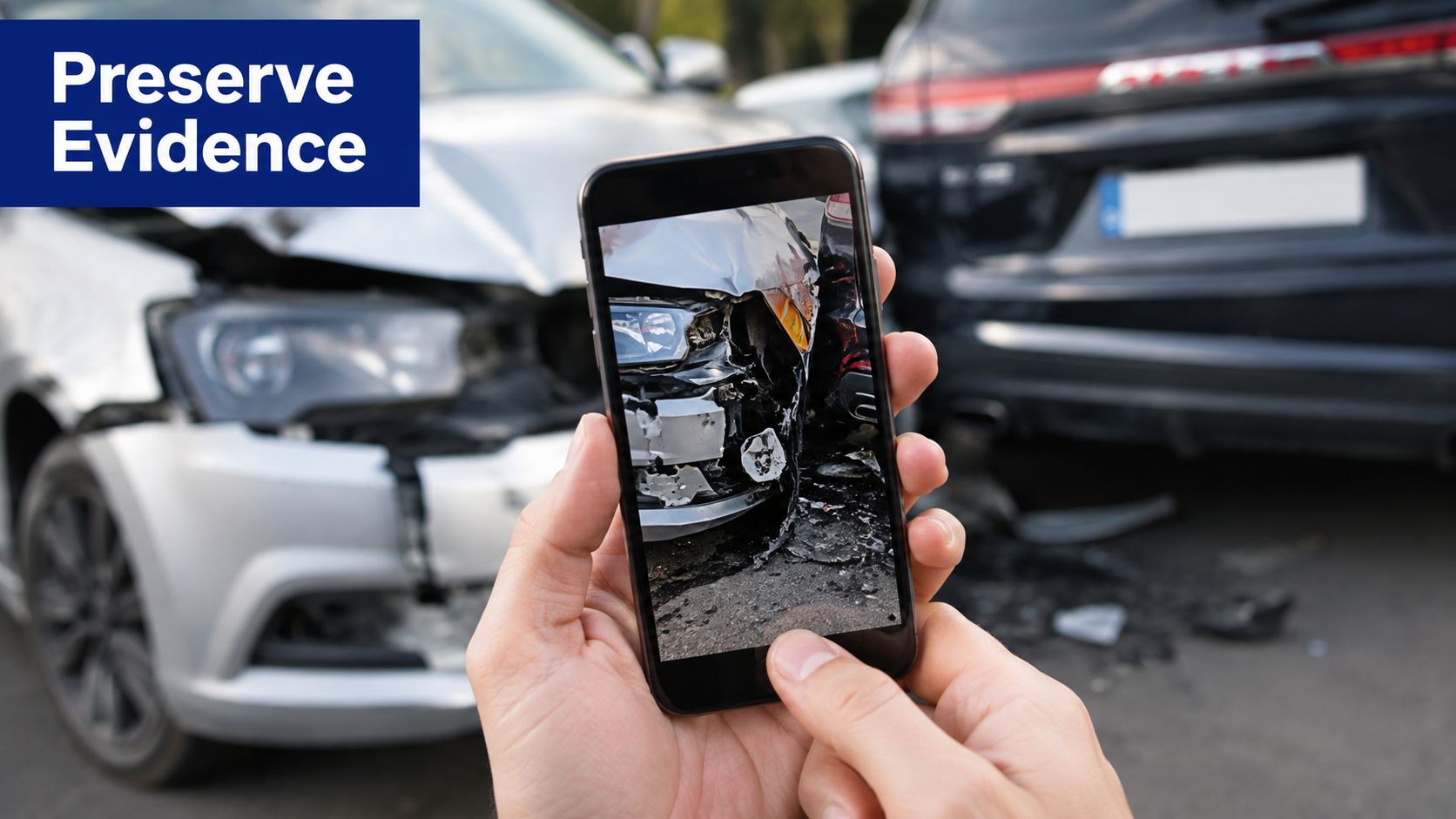
What to save right away
The most useful items are the ones that can vanish fast. Save the app screen, trip receipt, pickup and drop-off details, driver name, vehicle plate, and any in-app messages. If there were witnesses, get names and phone numbers before everyone leaves.
Digital data is especially important in these claims. GPS coordinates, trip timestamps, and app status can reconstruct the moments before impact, and attorneys often send rapid preservation letters because that information can be deleted or overwritten (The Oakes Firm on GPS data in rideshare accidents).
Why app data beats memory
Eyewitnesses disagree more often than people expect. One person sees a lane change, another sees a brake check, and the driver remembers the light turning yellow a second too late. Telemetry doesn't get tired, and it doesn't guess. It can show where the vehicle was, when the trip started, and whether the status changed before or after the collision.
That's also where attorney action becomes urgent. If the platform's logs are time-sensitive, waiting can cost the claim a clean liability story. For a separate reminder about why online activity can affect a Massachusetts injury case, review Shea Culgin Law's page on social media and a Brockton workers' comp claim. The same discipline applies here, keep the record quiet, complete, and consistent.
Bottom line: the best rideshare evidence is often electronic, not dramatic. Save it early, because later “proof” is usually less reliable.
Driver vs Company Who Is Actually Liable
Liability in a rideshare crash rarely stops with the person behind the wheel. The driver may be at fault, but another motorist may have caused the impact, a road defect may have contributed, or a vehicle problem may have made the crash worse. A strong claim looks at the whole chain, not just the most visible contact point.
The driver is often only the starting point
The rideshare driver can be personally liable for negligent driving, including distraction, speeding, or failure to yield. But the platform itself is a different question. These drivers are commonly treated as independent contractors, which makes direct claims against the company narrower than many injured people expect.
That doesn't end the analysis. If the company's own conduct contributed to the crash, or if its insurance layer is the source of recovery, the company still matters in practical terms. A claim can rise or fall on whether the facts support platform coverage, third-party negligence, or both.
Multi-party claims are often overlooked
Many online guides stop after saying “Uber or Lyft insurance applies depending on trip status.” That's too shallow for a real case. The harder question is what happens when another motorist, a municipality, or a vehicle manufacturer also played a role.
A thorough investigation may require pursuing compensation from another negligent driver, a local road authority, or a manufacturer if a defect contributed to the collision (LawyerDude on Uber accident liability). That matters because one policy may not cover the full loss, and one defendant may try to shift blame to another.
For a Massachusetts claim, that means no assumptions. A case involving a rideshare passenger struck by a second car is different from a pedestrian hit by an Uber vehicle on a defective road. For a related example of how third-party claims can arise in a company-vehicle setting, see Shea Culgin Law's discussion of a Massachusetts car accident in a company car. The same investigative instinct applies, identify every likely source of recovery before a settlement closes the door.
What a full liability review should ask
- Who started the chain? The rideshare driver, another vehicle, or a road hazard.
- Which policy was active? Personal, contingent, or commercial coverage.
- Who else contributed? A municipality, a part manufacturer, or another insured motorist.
- What proof exists? App logs, crash photos, vehicle data, and medical records.
A claim that only names the obvious driver can leave money on the table. The better question is who had the legal duty to prevent the crash.
Finding the Right Rideshare Accident Lawyer in MA
The right lawyer in a Massachusetts rideshare case should know more than vehicle damage and treatment notes. They should understand app status, layered insurance, third-party liability, and how digital evidence gets preserved before it disappears. That combination matters because rideshare claims aren't ordinary car cases with a different logo on the door.
What to look for
A strong Massachusetts lawyer should be able to explain, in plain language, which driver status was active and why that changes coverage. They should also know how to push for trip logs, GPS data, and preserved app records early, before the platform or insurer narrows the story.
The office should be able to handle the claim locally, not just by phone from far away. Brockton and the surrounding counties have their own courtroom rhythms, and a local presence helps with case management, document handling, and direct communication. Shea Culgin Law is one Massachusetts option that handles personal injury matters, including rideshare accident claims, on a contingency basis with free consultations.
A practical checklist before the first call
- Ask about rideshare cases specifically. Generic auto experience isn't enough.
- Ask how digital evidence is preserved. App logs and trip data should come up quickly.
- Ask whether multiple liable parties are reviewed. The answer should be yes.
- Ask about Massachusetts deadlines and coverage layers. Short deadlines and coverage issues can affect value right away.
- Ask who handles the file day to day. Direct attorney involvement matters.
The right choice should make the process feel organized, not overwhelming. If the crash involved Uber or Lyft and the insurance status is still unclear, getting the file reviewed early can keep the claim from drifting into the wrong coverage tier.
If the crash has already left you with medical appointments, missed work, or uncertainty about which insurer should pay, contact a Massachusetts rideshare accident lawyer now for a free consultation. Bring the app screenshots, the police report, and any photos you still have, and ask for a claim review before any settlement paperwork is signed.